آپ اس دنیا میں رہنے کے لائق نہیں ہیں. آپ تو سادھو بن کر کسی جنگل میں دھونی رما کر بقیہ زندگی گزار دیں
Showing posts with label Books Words and Readings. Show all posts
Showing posts with label Books Words and Readings. Show all posts
Saturday, October 29, 2016


Tuesday, October 1, 2013
He believed in God
"He believed in God, that it was his conviction that no man was so guilty that God would not forgive him, but in order for that to happen a man must repent and in doing so become like a child whose heart is open and ready to embrace all"
~The Stranger, Albert Camus
Monday, September 16, 2013
The coward does it with a kiss
“Yet each man kills the thing he loves
By each let this be heard
Some do it with a bitter look
Some with a flattering word
The coward does it with a kiss
The brave man with a sword”
Monday, July 22, 2013
Red wedding, take a hike!
"The survivors in Damascus are confronted on a dark night as the victorious Abbasids sweep into Syria and invite the Umayyad nobility to a "feast of reconciliation." ... The feast is to be held in the Umayyad palace, and everyone gathers ... The dinner is made up of the victors and the defeated ... when most are lulled by wine and food into the quiet of evening, the secret orders goes out among the visitors, and the terrible swords begin to do their duty. The Abbasids mercilessly slaughter every man, woman, and child of the Umayyad court, from cooks and servants to the wives of the harem, the sons and daughters, the cousins and retainers .... Nurseries, bedchambers, and kitchens become pools of blood, and the stones of Damascus ring out with a sound no one should ever have to hear ..."
~Morgan, M. H. (2007) Lost History. Washington, DC: National Geographic Society.
~Morgan, M. H. (2007) Lost History. Washington, DC: National Geographic Society.
Saturday, July 20, 2013

Thursday, August 2, 2012
ہر کہ مارا یار نبود ایزد اور ایار باد
ہر کہ مارا رنج دارد راھتش بسیار باد
ہر کسی درراہ ماخارے نہد از دشمنی
ہر گلے از باغ عمرش بیشگفد بے خار باد
حضرت خواجہ نظام الدین اولیا رحمتہ الله ~
Who does not become our friend, may Allah becomes his friend
One who hurts us, may he be bestowed with peace
One who spreads thorns in our way due to enmity
May every flower of the garden of his life blooms without a thorn
~ Khwaja Nizamuddin Auliya
~ Khwaja Nizamuddin Auliya
Wednesday, July 18, 2012

Wednesday, November 16, 2011

Wednesday, September 28, 2011
Love or farewell or recognition
Could she still draw back...? Her distress awoke a nausea in her body and she kept moving her lips in silent fervent prayer.
A bell clanged upon her heart. She felt him seize her hand:
-Come!
All the seas of the world tumbled about her heart. He was drawing her into them: he would drown her. She gripped with both hands at the iron railing.
-Come!
No! No! No! It was impossible. Her hands, clutched the iron in frenzy. Amid the seas she sent a cry of anguish!
-Eveline! Evvy!
He rushed beyond the barrier and called to her to follow. He was shouted at to go on but he still called to her. She set her white face to him, passive, like a helpless animal. Her eyes gave him no sign of love or farewell or recognition.
Eveline, Dubliners, James Joyce
Tuesday, July 19, 2011
Fatima is Fatima - Dr. Ali Shariati
Ali Shariati (November 23, 1933 in Kahak -
1975 in Southampton, England) was an Iranian revolutionary [1] and sociologist,
who focused on the sociology of religion. He is held as one of the most
influential Iranian intellectuals of the 20th century [2] and
has been called the 'ideologue of the Iranian Revolution'.
I was introduced to him through the writings of Basit Bilal
Koshul. Koshul’s work titled ‘Recounting the Milestones: An appraisal of Islam’s
Encounter with Modernity” also outlines the life and ideas of Ali
Shariati. (Read it here, page 66). According
to Koshul, Shariati was attempting to articulate a vision of Islam that made
Islam a living historical phenomenon, at the same time that it exposed the
vulgarity, hollowness and inanity of the attempts by the political and cultural
elite of Iran to uncritically import secular, Western culture into their
society.
I came across Ali Shariati’s lecture titled “Fatima is
Fatima” (Read it here) which he delivered at Husseineh Ershad, an educational
institutional established by Shariati in Tehran. The essence of the lecture is
very interesting and worth reading especially in today’s world where women are
divided between tradition and modernity. I have pasted some highlights from the
lecture below but before I end this post I would like to share with you a
paragraph from the above mentioned work of Koshul.
“Shariati notes that everything that has been said about “man” in the Qurab also applies to “woman” because, from the Quranic point of view, both are created from exactly the same nature and each is equally liable to be held accountable on the Day of Judgement for his or her deeds. Commenting on the popular misconception that the woman in created “..from the rib of the man,” Shariati notes that in Hebrew and Arabic one word means both “rib” and “nature”. During the process of translation, the word “rib” has been used more often with reference to the relationship of the creation of the women in relation to man. But the following ayah of the Quran makes it clear that the woman is created from the same nature as man:
And Allah made for you mates, of your own nature. (Al-Nahl 16:72)”
Highlights
A new class is created. It is characterized by foreignness and modernization. It adores the West. It is not religious. If it had a memory of or inclination towards religion, it has long since been stamped out. Luxury, transience, pretentiousness and foreignness prevail among this class. And their Islam, in the words of Sayyid Qutb, is an American Islam.
Woman, in their (traditional clergy) view, must also remain as she is today because, simply enough, her form existed in the past and has become part of social traditions. It may be 19th century, 17th century or even pre-Islamic, but it is considered to be religious and Islamic.
The idealistic schools of thought embrace the highest values, the absolute and most desirable ideologies. Each and every fact is categorically rejected if it does not suit them. They have no patience. They deny unpleasant realities and dig out the roots of anger. Anger, violence, pleasure seeking and greed are realities which do exist…
The opposite of idealism is realism. Its followers see everything, no matter how ugly or unpleasant, simply because it has an external existence. They accept a thing, attach their hearts to it and find faith. They oppose and reject, however, all beauty, truth and correctness simply because these do not record with existing realities. Through this rejection, they become unbelievers…
We (Muslims) only have the right to know fashion models and beauty queens. We have only the right to know movie sex goddesses in cheap exploitation films, the Queen of Monaco and all of the seven female guards around James Bond. Such women are the sacrifices made to European production of Europe. They are the toys and wind-up dolls of the wealthy. They are the slaves of the houses of the new merchants. We Muslims only have the right to know these examples of the women of European civilization. I have never seen photographs from Cambridge, the Sorbonne or Harvard University telling about female university students who go to the library to work on 14th and 15th century manuscripts and to research artifacts from 2500-3000 years ago in China. I have not seen pictures of those who bend over Quranic manuscripts based upon Latin. I have not seen pictures of those studying Greek, Cuneiform and Sanskrit texts without moving and without allowing their eyes to rove. They don't take their heads out of their books until the librarian takes their books away or asks them to leave.
We separate her from humanity. We thought that if she had beautiful handwriting, she would write to her lover. With this type of thinking, it would have been better if we had blinded her so she would never see a 'forbidden' person. In this way, Mr. Jealous, who feels the weaknesses of his own personality, would not have to worry about the disloyalty of his wife. He would be safe to the end of his life.
It was the Prophet who said, "Education is necessary for Muslims, both men and women." But it is always men who have had the right to be educated...
They said, a Woman will be freed-not by books or knowledge or the formation of a culture or clear-sighted vision or by raising the standard of living, or by common sense or by a new level of vision of the world, but rather with a pair of scissors. Yes. Putting scissors to the modest dress!" This is how they think that women will all at once become enlightened!
An Arab poet tells us, "If a father has a daughter and thinks of her future, he should think about three different sons-in-law: one, the house which will hide her; two, the husband who will keep her; and, three, the grave which will cover her! And the last one, the grave, is the best."
This is why the Koran, in the strongest terms, warns of the dangers of this frightening 'highest honor' when it says: He hides himself from the people. Should he keep her with disgrace or bury her alive in the dust? Behold, evil is what they decide" [16.59].
References
- 30th Anniversary of the Foundation of the Islamic Republic, A Revolution Misunderstood. Charlotte Wiedemann
- Gheissari, Ali. 1998. Iranian Intellectuals in the Twentieth Century. Austin: University of Texas Press.
- Abrahamian, Ervand. 1993. ‘Ali Shariati: ideologue of the Iranian revolution’. In Edmund Burke and Ira Lapidus (eds.), Islam, politics, and social movements. Los Angeles: University of California Press. First published in MERIP Reports (January 1982): 25-28
Monday, May 23, 2011
Monday, April 11, 2011
I Can't Think!
"You need to pull back from the constant influx and take a break.”
So what are you? Sufficer or Maximizer?
Monday, February 21, 2011
Friday, July 30, 2010
TIME Cover (29-07-10)
The upcoming TIME magazine’s cover depicting an 18 year old Afghan girl, who had her nose and ears cut by the Taliban regime for leaving her abusive in-laws, is definitely going to create ripples. People have already started to comment on the very graphic cover and it is bound to be interpreted in numerous ways. I have yet to read the cover story but the title, ‘What happens if we leave Afghanistan’, says a lot about what lies inside. Although the managing editor clearly states, ‘We do not run this story or show this image either in support of the U.S. war effort or in opposition to it’ but I think it only takes grade one journalism/psychology to understand what would be the most likely implications.
To me it is another one of those desperate attempts to justify the wars. One could easily bring out a thousand graphical pictures of people who suffered and are still suffering due to incessant bombardment and assault of allied forces but that is very conveniently termed as collateral damage.
Everything doesn’t follow everything. Wrongs of Taliban regime can never be a justification for the ‘U.S. war effort’. They should be rather thinking what happens if we don't leave Afghanistan?
Read more: http://www.time.com/time/world/article/0,8599,2007269,00.html
Tuesday, October 6, 2009
Grey Wolf - Mustafa Kemal by H.C.Armstrong
Fundamentally a revolutionary and with no respect for god or institution, Mustafa Kemal was a true fighter. List of his achievements can easily confound the mind. From epic victories against fierce enemies to taking out Turkey from dregs, his strength and stamina were unmatchable. Single handedly he fashioned the entire nation on new grounds and paved way for a better and prosperous future. “Turkey for Turks” was the only aim throughout his life.
Conservatives might flinch at most of his actions but there is no denying the fact that he was a mountain in the face of an alarming number of external and internal problems. Abolishing the caliphate and putting an end to the centuries old rotting system was not an easy job. He had to change the whole mentality and induce a new spirit in the nation. Arts were modernized and Arabic characters of language were changed to Latin to end the superiority of handful of priests, remnants of the historical relic, the caliphate.Eons of oppression and manipulation at the hands of degrading clerics had shut all avenues of change. It needed an overhaul, a revolution.
Revolution did come; founded in blood to ensure its permanence. “Some of you may agree or may not nonetheless it will happen, only some of your heads will fall in process”, Mustafa said to the Grand National assembly, on their refusal of his proposal that the sultanate should be separated from the caliphate.
He firmly believed that there are no oppressors or any oppressed; there are only those who allow themselves to be oppressed. With this notion he led his people by hand along the road until their feet were sure and they knew the way.
In an almost story like manner the author, H.C. Armstrong sketches the life and works of Mustafa Kemal, the founding father of modern Turkey. The somewhat boring details which are usually part and parcel of such books are engulfed in such a manner that you feel like reading a great novel. It was certainly a wholesome read.
Conservatives might flinch at most of his actions but there is no denying the fact that he was a mountain in the face of an alarming number of external and internal problems. Abolishing the caliphate and putting an end to the centuries old rotting system was not an easy job. He had to change the whole mentality and induce a new spirit in the nation. Arts were modernized and Arabic characters of language were changed to Latin to end the superiority of handful of priests, remnants of the historical relic, the caliphate.Eons of oppression and manipulation at the hands of degrading clerics had shut all avenues of change. It needed an overhaul, a revolution.
Revolution did come; founded in blood to ensure its permanence. “Some of you may agree or may not nonetheless it will happen, only some of your heads will fall in process”, Mustafa said to the Grand National assembly, on their refusal of his proposal that the sultanate should be separated from the caliphate.
He firmly believed that there are no oppressors or any oppressed; there are only those who allow themselves to be oppressed. With this notion he led his people by hand along the road until their feet were sure and they knew the way.
In an almost story like manner the author, H.C. Armstrong sketches the life and works of Mustafa Kemal, the founding father of modern Turkey. The somewhat boring details which are usually part and parcel of such books are engulfed in such a manner that you feel like reading a great novel. It was certainly a wholesome read.
Saturday, June 20, 2009
A will for all seasons
Hazrat Sheikh Khutli's (R.A) will to Hazrat Ali Hajveri (R.A) ...
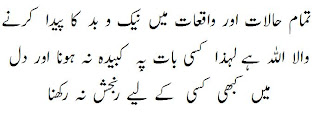
For the past few weeks I have involuntarily kept repeating these lines to myself. People have cried defeatism and whole lot of other things. The initial fear being becoming less ambitious but these words don't really have to hold you down as you kick start rather they can also sooth you once you have crossed the finish line. Not necessarily if you are the last one to cross the line but even if you are the first, this piece of advice can be helpful. Ramifications and interpretations of this will can be endless and profound.
Cry what they may, life does become less complicated.
Saturday, April 4, 2009
Amrita Pritam - Raseedi Ticket
I have just finished reading Amrita Pritam’s autobiography, Raseedi Ticket. I hadn’t read any of her works before and it was a nice introduction indeed. I would also recommend reading this article; it gives a good insight into the life and works of Amrita Pritam.
My rough translation of a few excerpts from Amrita Pritam’s Raseedi Ticket.
“The wedding procession had arrived and dinner had been served. Father got a message that if a relative asks; tell them that this much money has been given as dowry. Father took this message as an indication. He didn’t have that kind of money, he panicked.
We fretted for hours. A friend of my late mother who had come that day as a guest understood everything. She took us aside, removed the gold bangles from her hand and placed them in front of my father. Father’s eyes had tears but for me seeing all this was worse than death.
Then we got to know that the message delivered earlier wasn’t some kind of indication rather a way to satisfy some relatives. Mother’s friend put his bangles back on. But it feels that moment, during which she removed those bangles, as a symbol, will always remain standing in the history of world’s goodness.”
"My writings; poem or prose…I know are like an illegitimate child. The reality of my world fell in love with the dream of my heart and this banned union produced my writings.
I know, my writings would have a fate like the fate of an illegitimate child and it would have to face the frowns of the literary society all his life...”
This poem below was written on the massacre of 1947. It would be a good idea to listen or read the original version first. Here.
'I call upon Waris Shah today: speak from your grave
And add a new page to your book of love
Once, one daughter of Punjab wept, and you wrote your long saga;
Today, thousands weep, calling to you Waris Shah:
Arise, o friend of the afflicted; arise and see the state of Punjab,
Corpses strewn on fields, and the Chenab flowing with much blood.
Someone filled the five rivers with poison,
And this same water now irrigates our soil.
Where was lost the flute, where the songs of love sounded?
And all Ranjha’s brothers forgotten to play the flute.
Blood has rained on the soil, graves are oozing with blood,
The princesses of love cry their hearts out in the graveyards.
Today all the Kaidos have become the thieves of love and beauty,
Where can we find another one like Waris Shah?
Waris Shah! I say to you, speak from your grave
And add a new page to your book of love.'
(Translated by Darshan Singh Maini, Studies in Punjabi Poetry)
My rough translation of a few excerpts from Amrita Pritam’s Raseedi Ticket.
“The wedding procession had arrived and dinner had been served. Father got a message that if a relative asks; tell them that this much money has been given as dowry. Father took this message as an indication. He didn’t have that kind of money, he panicked.
We fretted for hours. A friend of my late mother who had come that day as a guest understood everything. She took us aside, removed the gold bangles from her hand and placed them in front of my father. Father’s eyes had tears but for me seeing all this was worse than death.
Then we got to know that the message delivered earlier wasn’t some kind of indication rather a way to satisfy some relatives. Mother’s friend put his bangles back on. But it feels that moment, during which she removed those bangles, as a symbol, will always remain standing in the history of world’s goodness.”
"My writings; poem or prose…I know are like an illegitimate child. The reality of my world fell in love with the dream of my heart and this banned union produced my writings.
I know, my writings would have a fate like the fate of an illegitimate child and it would have to face the frowns of the literary society all his life...”
This poem below was written on the massacre of 1947. It would be a good idea to listen or read the original version first. Here.
'I call upon Waris Shah today: speak from your grave
And add a new page to your book of love
Once, one daughter of Punjab wept, and you wrote your long saga;
Today, thousands weep, calling to you Waris Shah:
Arise, o friend of the afflicted; arise and see the state of Punjab,
Corpses strewn on fields, and the Chenab flowing with much blood.
Someone filled the five rivers with poison,
And this same water now irrigates our soil.
Where was lost the flute, where the songs of love sounded?
And all Ranjha’s brothers forgotten to play the flute.
Blood has rained on the soil, graves are oozing with blood,
The princesses of love cry their hearts out in the graveyards.
Today all the Kaidos have become the thieves of love and beauty,
Where can we find another one like Waris Shah?
Waris Shah! I say to you, speak from your grave
And add a new page to your book of love.'
(Translated by Darshan Singh Maini, Studies in Punjabi Poetry)
Saturday, March 7, 2009
Ya Khuda - Qudrut-ullah-Shahaab
 While reviewing this book, a young journalist, Azhar Sohail wrote in 1985
 “It was perhaps 1959. I saw my father bring home a small book. While he read the book, he wept incessantly. When he was finished I grabbed the book from his cupboard, completed it within an hour but didn’t cry.
Four years back I read the book again and there were tears in my eyes. Then like a bolt of flash I understood that this book makes you cry when your conscience has matured”
I have just read the book. It didn’t make me cry but yes, I felt this unexplainable anger. I still don’t know at what I was angry. Was it the shallowness of mankind, moral degradation of self-proclaimed religious scholars, depravity of political leaders or was I angry because even after 60 years we are standing exactly where we started. We are still being led by those scholars and leaders. We haven’t learnt a thing.
The book tells the tale of the atrocities faced by a girl at the hands of her own countrymen when she migrated from India in 1947. How she died again and again before her last death. How her colorful and fancy dreams about the new nation were battered and bruised after coming to Pakistan.
It is a far greater tragedy being betrayed by one’s own people. Reading this book is like getting resounding slaps on your face because the story is true and all the characters are real. All those characters are still very much part of our society. They still roam around; prowling and hunting for more. Their thirst is insatiable. This book only tells about one of the thousands such stories. Qudrut was right in saying,
“While I waited at the Wahga Border for my relatives, I witnessed scenes which even after thousand attempts my pen is unable to write down completely”.
Such was the horror of that calamity and such is the sorry situation of today’s Pakistan.
Wednesday, March 4, 2009
Kindness of Strangers
This is one of the stories which truly warms the heart, gives a hope...
After spending a weekend away with my adult son, I was so impressed by his generous heart, I sent him the following e-mail.
"Dear Son, I want to thank you for teaching me a very valuable lesson in life by the great example you set. When we were eating at that cafe in Bondi and a person who’d ordered his burger didn’t have enough money to pay for it, without a moment’s hesitation, you leant over and put the extra $2 on the counter...
Read the complete story at
http://www.readersdigest.co.nz/content/stories-of-kindness/2/?commentPageIndex=0&orderCommentsBy=0
After spending a weekend away with my adult son, I was so impressed by his generous heart, I sent him the following e-mail.
"Dear Son, I want to thank you for teaching me a very valuable lesson in life by the great example you set. When we were eating at that cafe in Bondi and a person who’d ordered his burger didn’t have enough money to pay for it, without a moment’s hesitation, you leant over and put the extra $2 on the counter...
Read the complete story at
http://www.readersdigest.co.nz/content/stories-of-kindness/2/?commentPageIndex=0&orderCommentsBy=0
Subscribe to:
Posts (Atom)